Trending...
- After 35 Years, Christian Radio Host Marina Maria Publishes the Novel She Never Forgot
- NEW Three Fully Furnished Single-Family Model Homes at Heritage at South Brunswick
- Freight Broker 911 CEO and President Milton Collier Is Rebuilding the Path Into Freight Brokerage

Strategic Appointments Bring Decades of U.S. Military and Government Experience to (NAS DAQ: ASTI) $ASTI as NASA-Related Testing, MEO/GEO Qualification, Spacecraft Deployments, Drones, HAPS and Autonomous Systems Expand the Company's Commercial Opportunity
THORNTON, Colo. - WisconsinEagle -- Ascent Solar Technologies, Inc. (N A S D A Q: ASTI) continues to build a potentially differentiated position at the intersection of space technology, advanced solar power, national defense and autonomous systems, and today's announcement adds another important piece to that strategy.
The company announced the appointment of Tom Bawol as Director of Strategic Sales & Market Development and LTG. Steve Smith as Strategic Advisor to Ascent's Strategic Advisory Board. Together, the appointments bring decades of military leadership, strategic planning, government relationships, operational management and business-development experience to Ascent as it seeks to expand the commercial reach of its proprietary thin-film photovoltaic technology.
For investors, the timing is particularly interesting.
Today's leadership expansion comes only weeks after Ascent announced that it is broadening its space photovoltaic testing program beyond Low Earth Orbit, building upon encouraging NASA testing and moving toward qualification in Medium Earth Orbit (MEO), Geostationary Orbit (GEO) and other high-energy orbital environments.
Investor Highlights
Today's News: Defense and Commercial Expertise Moves to the Forefront
Today's announcement is significant because Ascent is not simply adding corporate executives—it is adding people with experience in precisely the types of markets where the company's technology could have strategic value.
Tom Bawol, the company's new Director of Strategic Sales & Market Development, spent more than 20 years as a leader in U.S. Army Special Forces. His background includes complex operations, partnership development and working with government, defense and commercial stakeholders. He has also gained private-sector experience in energy infrastructure and federal technology sales.
Bawol will focus on identifying and developing commercial opportunities and strategic relationships for Ascent's thin-film photovoltaic technology.
LTG. Steve Smith, meanwhile, joins the Strategic Advisory Board as Strategic Advisor. His military career included senior leadership involving large-scale operations, logistics, technology integration and multinational partnerships. More recently, he served as Deputy Commanding General of Western Hemisphere Command, where he oversaw approximately 700,000 personnel and a $4.8 billion budget.
For ASTI, this experience could be particularly valuable as the company seeks to expand into defense and government-related applications.
More on Wisconsin Eagle
NASA Remains a Major Part of the ASTI Story
One of the most compelling elements of the current Ascent Solar investment story is its continuing work related to NASA and advanced space-power technology.
In February, ASTI announced plans to continue developing CIGS photovoltaic modules designed for space-based energy beaming, including continued work with NASA's Marshall Space Flight Center and Glenn Research Center.
The objective is to develop photovoltaic technology capable of receiving distributed power from sources beyond conventional sunlight—an area that could become increasingly important as space-based infrastructure develops.
ASTI has specifically identified emerging markets such as orbital data centers, in-space manufacturing and other high-power orbital applications as potential beneficiaries of advanced space power-beaming technology.
NASA Results Now Lead to MEO and GEO Testing
The NASA connection becomes even more interesting when combined with the company's August 18 announcement.
ASTI said previous NASA testing in Low Earth Orbit demonstrated the potential for its CIGS photovoltaic technology to recover from radiation exposure through self-annealing, a phenomenon described in scholarly literature as "Remarkable Recovery."
Now, the company is taking that research further.
ASTI is preparing in-house characterization campaigns to determine whether similar radiation-recovery characteristics can occur in the much more demanding environments of MEO, GEO and other high-energy orbits.
The expanded testing program is expected to continue through Q4 2026.
Why does that matter?
Because the next generation of space infrastructure may not be confined to traditional LEO satellites. Emerging markets involving on-orbit servicing and assembly, space-based solar power, orbital data centers and advanced manufacturing could require solar systems capable of operating reliably under significantly harsher conditions.
Atomic Oxygen Testing Adds Another Layer of Validation
The company's June 29 announcement provided another important technology milestone.
ASTI reported that its space-grade thin-film photovoltaic products experienced zero power loss during Atomic Oxygen exposure testing equivalent to approximately six months at the altitude of the International Space Station, approximately 400 kilometers.
Atomic Oxygen is an especially challenging factor in LEO because it can erode polymers, coatings and other materials used in spacecraft solar-array construction.
ASTI is now proceeding with additional testing designed to simulate longer mission durations.
For investors, the combination of radiation-related NASA testing and Atomic Oxygen resilience testing provides a growing body of environmental-performance data supporting the company's space technology strategy.
Real Spacecraft Applications Are Already Emerging
Ascent's opportunity is not limited to laboratory testing.
Earlier this year, the company announced that its previously delivered flexible PV blankets had been successfully integrated into NOVI Space's N-1 ATLAS spacecraft, scheduled to fly aboard a SpaceX Falcon 9 Transporter mission.
The spacecraft's design uses a tightly rolled CIGS array, allowing the solar system to be stowed efficiently while supporting approximately 150 watts of power generation.
ASTI has also reported a 100-module order supporting another satellite program focused on in-space manufacturing.
These developments are important because they demonstrate the transition from technology development toward actual spacecraft integration and commercial customer activity.
Drones and HAPS Expand the Addressable Market
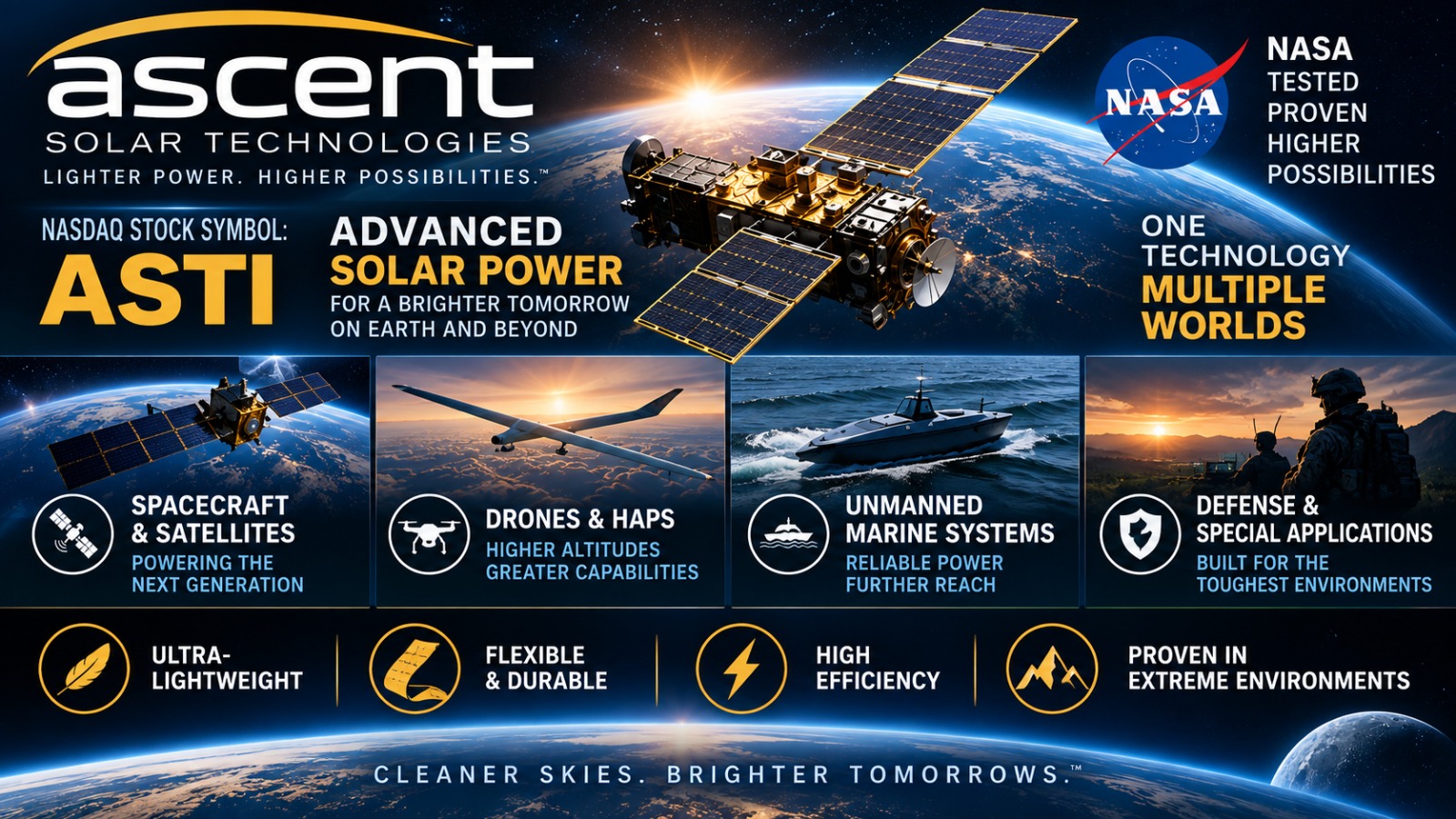
Although space remains ASTI's primary strategic focus, the company is increasingly finding opportunities for its lightweight solar technology in unmanned systems.
More on Wisconsin Eagle
In August, ASTI reported initial orders from two Eastern European drone manufacturers for wing integration, with potential recurring annual demand estimated at approximately 200–300 kilowatts as production develops.
The company is also pursuing a European High-Altitude Platform Station (HAPS) opportunity.
HAPS and HALE platforms can potentially provide communications, surveillance and other capabilities from high altitudes, where lightweight and reliable power generation becomes particularly valuable.
These opportunities demonstrate how the same CIGS technology developed for space can potentially be adapted for high-altitude and unmanned aircraft applications.
Autonomous Marine Systems Add Yet Another Market
ASTI is also developing opportunities in unmanned marine systems.
The company has reported initial product orders from two unmanned marine vehicle companies, creating another potential market for lightweight, flexible photovoltaic technology.
This diversification could become strategically important because ASTI can potentially leverage its core CIGS platform across several specialized markets without abandoning its primary space focus.
H1 2026 Demonstrated Increasing Commercial Activity
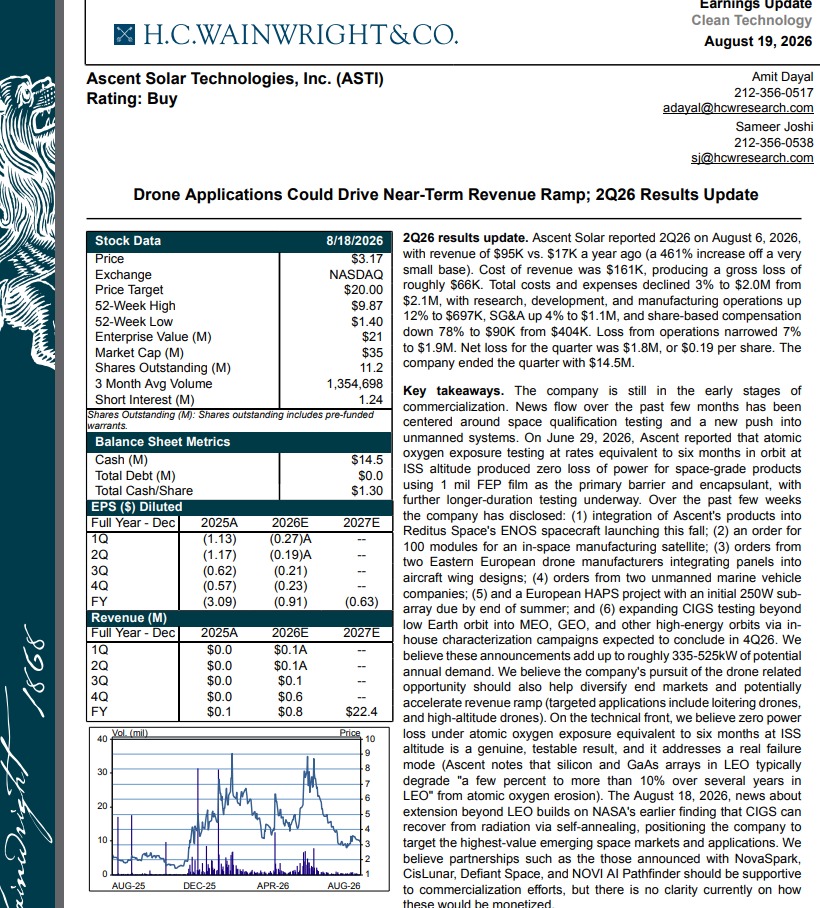
In its July H1 update, Ascent reported completing prepaid customer orders for space, HAPS/HALE and specialized terrestrial applications, completing Atomic Oxygen testing, continuing space power-beaming development, pursuing European business opportunities and closing an up-to-$25 million private placement.
Management also outlined goals for the remainder of 2026 that include developing new business relationships, securing repeat orders, enhancing thin-film PV technology, conducting additional environmental testing and progressing UAV and HAPS arrays for European partners.
That creates a potentially important second-half roadmap for investors to watch.
Investment Perspective
Today's announcement adds another layer to what has become an increasingly interesting ASTI story.
Ascent Solar is attempting to position its proprietary CIGS thin-film photovoltaic technology for environments where conventional solar panels can face limitations involving weight, flexibility, durability and resilience.
The company's recent progression is notable:
NASA-related testing → radiation self-annealing research → MEO/GEO qualification → Atomic Oxygen testing → spacecraft deployments → space power-beaming → drones → HAPS → unmanned marine systems → expanded defense expertise.
The addition of Tom Bawol and LTG. Steve Smith could help ASTI turn some of these technological advantages into new government, defense and commercial relationships.
At the same time, investors should recognize that Ascent remains an emerging technology company and that successful commercialization, customer adoption, financing and execution remain critical factors.
Nevertheless, the opportunity is becoming increasingly broad.
As the global space economy expands and governments invest heavily in defense, autonomous systems and next-generation orbital infrastructure, the demand for lightweight, reliable and resilient power generation could become increasingly important.
With today's leadership appointments, ASTI is adding significant military and government expertise to an already expanding technology platform—while its NASA-related results, multi-orbit testing program, spacecraft deployments and growing unmanned-systems opportunities continue to develop.
For investors watching the intersection of NASA, advanced solar technology, space infrastructure, defense and autonomous systems, N A S D A Q: ASTI remains a company worth watching closely as it works to turn decades of thin-film PV development into a new generation of commercial opportunities.
For more information on $ASTI visit: https://www.ascentsolar.com https://compasslivemedia.com/asti/
Media Contact
Company Name: Ascent Solar Technologies, Inc (N A S D A Q: ASTI)
Contact Person: Paul Warley, CEO
Email: sales@ascentsolar.com
Phone: (720) 872-5000
Country: United States
Website: https://www.ascentsolar.com
DISCLAIMER: https://corporateads.com/disclaimer/
Disclosure listed on the CorporateAds website
The company announced the appointment of Tom Bawol as Director of Strategic Sales & Market Development and LTG. Steve Smith as Strategic Advisor to Ascent's Strategic Advisory Board. Together, the appointments bring decades of military leadership, strategic planning, government relationships, operational management and business-development experience to Ascent as it seeks to expand the commercial reach of its proprietary thin-film photovoltaic technology.
For investors, the timing is particularly interesting.
Today's leadership expansion comes only weeks after Ascent announced that it is broadening its space photovoltaic testing program beyond Low Earth Orbit, building upon encouraging NASA testing and moving toward qualification in Medium Earth Orbit (MEO), Geostationary Orbit (GEO) and other high-energy orbital environments.
Investor Highlights
- Today's appointments strengthen ASTI's defense and government-market expertise
- Tom Bawol brings more than 20 years of U.S. Army Special Forces leadership
- LTG. Steve Smith joins as a Strategic Advisor following senior U.S. Army leadership roles
- NASA-related testing demonstrated potential radiation recovery through CIGS self-annealing
- ASTI is expanding testing into MEO, GEO and other high-energy orbits
- June Atomic Oxygen testing showed zero power loss under the company's six-month LEO-equivalent test conditions
- ASTI continues developing space-based power-beaming technology with NASA centers
- Thin-film PV blankets have been integrated into the NOVI N-1 ATLAS spacecraft
- New opportunities are developing across drones, HAPS/HALE and unmanned marine systems
- The company has a 5-MW nameplate production facility in Thornton, Colorado
- ASTI says it has approximately 40 years of R&D and 15 years of manufacturing experience
Today's News: Defense and Commercial Expertise Moves to the Forefront
Today's announcement is significant because Ascent is not simply adding corporate executives—it is adding people with experience in precisely the types of markets where the company's technology could have strategic value.
Tom Bawol, the company's new Director of Strategic Sales & Market Development, spent more than 20 years as a leader in U.S. Army Special Forces. His background includes complex operations, partnership development and working with government, defense and commercial stakeholders. He has also gained private-sector experience in energy infrastructure and federal technology sales.
Bawol will focus on identifying and developing commercial opportunities and strategic relationships for Ascent's thin-film photovoltaic technology.
LTG. Steve Smith, meanwhile, joins the Strategic Advisory Board as Strategic Advisor. His military career included senior leadership involving large-scale operations, logistics, technology integration and multinational partnerships. More recently, he served as Deputy Commanding General of Western Hemisphere Command, where he oversaw approximately 700,000 personnel and a $4.8 billion budget.
For ASTI, this experience could be particularly valuable as the company seeks to expand into defense and government-related applications.
More on Wisconsin Eagle
- Vegan Kingz Expands Direct-Import Wholesale Lineup to Help Commercial Kitchens Cut Ingredient Costs
- Everything Policy Unveils Their Classroom Resources Behind Every Policy Topic
- Acuvance Survey Finds ERP Integration Remains a Key Challenge as Healthcare Organizations Prepare for AI
- Constantine "Costa" Kapothanasis II Acquires The Lubri-Loy Company, Carrying a 77-Year-Old American Lubricant Brand Into Its Next Era
- LS2 Partners with Angels Of Dirt's "Next Chapter Racer" Series Celebrating Women and Girls in Motorsports
NASA Remains a Major Part of the ASTI Story
One of the most compelling elements of the current Ascent Solar investment story is its continuing work related to NASA and advanced space-power technology.
In February, ASTI announced plans to continue developing CIGS photovoltaic modules designed for space-based energy beaming, including continued work with NASA's Marshall Space Flight Center and Glenn Research Center.
The objective is to develop photovoltaic technology capable of receiving distributed power from sources beyond conventional sunlight—an area that could become increasingly important as space-based infrastructure develops.
ASTI has specifically identified emerging markets such as orbital data centers, in-space manufacturing and other high-power orbital applications as potential beneficiaries of advanced space power-beaming technology.
NASA Results Now Lead to MEO and GEO Testing
The NASA connection becomes even more interesting when combined with the company's August 18 announcement.
ASTI said previous NASA testing in Low Earth Orbit demonstrated the potential for its CIGS photovoltaic technology to recover from radiation exposure through self-annealing, a phenomenon described in scholarly literature as "Remarkable Recovery."
Now, the company is taking that research further.
ASTI is preparing in-house characterization campaigns to determine whether similar radiation-recovery characteristics can occur in the much more demanding environments of MEO, GEO and other high-energy orbits.
The expanded testing program is expected to continue through Q4 2026.
Why does that matter?
Because the next generation of space infrastructure may not be confined to traditional LEO satellites. Emerging markets involving on-orbit servicing and assembly, space-based solar power, orbital data centers and advanced manufacturing could require solar systems capable of operating reliably under significantly harsher conditions.
Atomic Oxygen Testing Adds Another Layer of Validation
The company's June 29 announcement provided another important technology milestone.
ASTI reported that its space-grade thin-film photovoltaic products experienced zero power loss during Atomic Oxygen exposure testing equivalent to approximately six months at the altitude of the International Space Station, approximately 400 kilometers.
Atomic Oxygen is an especially challenging factor in LEO because it can erode polymers, coatings and other materials used in spacecraft solar-array construction.
ASTI is now proceeding with additional testing designed to simulate longer mission durations.
For investors, the combination of radiation-related NASA testing and Atomic Oxygen resilience testing provides a growing body of environmental-performance data supporting the company's space technology strategy.
Real Spacecraft Applications Are Already Emerging
Ascent's opportunity is not limited to laboratory testing.
Earlier this year, the company announced that its previously delivered flexible PV blankets had been successfully integrated into NOVI Space's N-1 ATLAS spacecraft, scheduled to fly aboard a SpaceX Falcon 9 Transporter mission.
The spacecraft's design uses a tightly rolled CIGS array, allowing the solar system to be stowed efficiently while supporting approximately 150 watts of power generation.
ASTI has also reported a 100-module order supporting another satellite program focused on in-space manufacturing.
These developments are important because they demonstrate the transition from technology development toward actual spacecraft integration and commercial customer activity.
Drones and HAPS Expand the Addressable Market
Although space remains ASTI's primary strategic focus, the company is increasingly finding opportunities for its lightweight solar technology in unmanned systems.
More on Wisconsin Eagle
- Breathwork Certification in Milwaukee, Wisconsin: June 2027 Training a Train Ride From Chicago
- Danish company biosuite introduces biotech procurement software to track outsourced R&D commitments
- Industrial & systems engineering educator and professional to lead global strategic partnerships for professional society
- Convergence of AI, Wearable Technology, Remote Patient Monitoring and Real-World Healthcare: PomDoctor Ltd. (N A S D A Q: POM)
- Service Guys Urges Ontario Homeowners to Book Chimney Cleaning and WETT Inspections Before the 2026 Heating Season
In August, ASTI reported initial orders from two Eastern European drone manufacturers for wing integration, with potential recurring annual demand estimated at approximately 200–300 kilowatts as production develops.
The company is also pursuing a European High-Altitude Platform Station (HAPS) opportunity.
HAPS and HALE platforms can potentially provide communications, surveillance and other capabilities from high altitudes, where lightweight and reliable power generation becomes particularly valuable.
These opportunities demonstrate how the same CIGS technology developed for space can potentially be adapted for high-altitude and unmanned aircraft applications.
Autonomous Marine Systems Add Yet Another Market
ASTI is also developing opportunities in unmanned marine systems.
The company has reported initial product orders from two unmanned marine vehicle companies, creating another potential market for lightweight, flexible photovoltaic technology.
This diversification could become strategically important because ASTI can potentially leverage its core CIGS platform across several specialized markets without abandoning its primary space focus.
H1 2026 Demonstrated Increasing Commercial Activity
In its July H1 update, Ascent reported completing prepaid customer orders for space, HAPS/HALE and specialized terrestrial applications, completing Atomic Oxygen testing, continuing space power-beaming development, pursuing European business opportunities and closing an up-to-$25 million private placement.
Management also outlined goals for the remainder of 2026 that include developing new business relationships, securing repeat orders, enhancing thin-film PV technology, conducting additional environmental testing and progressing UAV and HAPS arrays for European partners.
That creates a potentially important second-half roadmap for investors to watch.
Investment Perspective
Today's announcement adds another layer to what has become an increasingly interesting ASTI story.
Ascent Solar is attempting to position its proprietary CIGS thin-film photovoltaic technology for environments where conventional solar panels can face limitations involving weight, flexibility, durability and resilience.
The company's recent progression is notable:
NASA-related testing → radiation self-annealing research → MEO/GEO qualification → Atomic Oxygen testing → spacecraft deployments → space power-beaming → drones → HAPS → unmanned marine systems → expanded defense expertise.
The addition of Tom Bawol and LTG. Steve Smith could help ASTI turn some of these technological advantages into new government, defense and commercial relationships.
At the same time, investors should recognize that Ascent remains an emerging technology company and that successful commercialization, customer adoption, financing and execution remain critical factors.
Nevertheless, the opportunity is becoming increasingly broad.
As the global space economy expands and governments invest heavily in defense, autonomous systems and next-generation orbital infrastructure, the demand for lightweight, reliable and resilient power generation could become increasingly important.
With today's leadership appointments, ASTI is adding significant military and government expertise to an already expanding technology platform—while its NASA-related results, multi-orbit testing program, spacecraft deployments and growing unmanned-systems opportunities continue to develop.
For investors watching the intersection of NASA, advanced solar technology, space infrastructure, defense and autonomous systems, N A S D A Q: ASTI remains a company worth watching closely as it works to turn decades of thin-film PV development into a new generation of commercial opportunities.
For more information on $ASTI visit: https://www.ascentsolar.com https://compasslivemedia.com/asti/
Media Contact
Company Name: Ascent Solar Technologies, Inc (N A S D A Q: ASTI)
Contact Person: Paul Warley, CEO
Email: sales@ascentsolar.com
Phone: (720) 872-5000
Country: United States
Website: https://www.ascentsolar.com
DISCLAIMER: https://corporateads.com/disclaimer/
Disclosure listed on the CorporateAds website
Source: CorporateAds
0 Comments
Latest on Wisconsin Eagle
- Postmortem Pathology Highlights Private Autopsy Options for Las Vegas Families During Summer Months
- Postmortem Pathology Offers Sacramento Families Independent Answers on a Short Timeline
- NEW Three Fully Furnished Single-Family Model Homes at Heritage at South Brunswick
- After 35 Years, Christian Radio Host Marina Maria Publishes the Novel She Never Forgot
- Freight Broker 911 CEO and President Milton Collier Is Rebuilding the Path Into Freight Brokerage
- Boston Industrial Solutions Launches New and Improved Siliart Website for Silicone Decorators
- Scoop Social Co. Brings Its Signature Mobile Dessert Experience to Phoenix
- Sky Quarry's Big Turning Point: CEO Marcus Laun Outlines the Next Phase for N A S D A Q: SKYQ
- Hunter Is Releasing New Music For The Holidays!
- Tixpool.com - Naija Premier Event Reseller
- Work 365 Expands Distributor Integrations with Companial for Microsoft Partners
- Guardian Data Opens 42,000-Square-Foot Moonachie Facility, Doubling New Jersey Capacity
- SecureMaine 2026 is Here -- Thursday October 8th!
- HW Foundation Opens Nominations for Inaugural 50 Under 50 in AI; Deadline Oct. 16
- Pavillon 30 Years of Addiction Recovery in Western North Carolina, Earns National Accreditation
- ResC4EU Final Event at KOMPOZYT-EXPO 2026 – Building Resilient European Supply Chains
- CardsNearby Launches Free Nationwide Directory of Card Shows and Local Card Shops for Collectors
- Award-winning novelist Edward Underhill headlines opening night of 2026 Southeast Wisconsin Festival of Books
- American Garden Rose Selections™ Announces 2027 Winners
- Crossroads4Hope Launches Blood Cancer Resource Hub